Digital platforms & commerce firm
How we helped
a digital partner
find its next customers.
Read the case ABOUT THE COMPANY
Connected platforms.
For complex businesses.
Our client builds enterprise websites, commerce platforms and customer portals for international businesses.
THE BRIEF
Find the companies approaching
their next digital project.
A company can fit the market without needing help today. We worked back from comparable projects to understand the changes worth investigating.
Find the buying window.
Begin with comparable customer projects. Work back from what changed.
01 / THE STARTING POINT
Start with the work our client wants to win.
Our client builds websites, commerce platforms and customer portals. We started with the businesses they serve—and the work those businesses need to get done.
The client’s offer covers enterprise websites, commerce, portals and integration. The target market is European and US businesses with €100m+ revenue and 100+ staff.
The client brief+
Our client wanted more of the less-visible, established businesses with international complexity—not simply a list of the largest brands. We separated the target prospect profile from the broader comparison cohort used in the research.
02 / THE COMPETITOR UNIVERSE
Find the agencies winning similar work.
The client named seven competitors. We widened the search through industry directories, then read the services and customer work behind each name.
Seven client-named competitors and 45 directory firms formed a 52-agency comparison. We mapped 23,086 URL paths and read 794 pages.
What we compared+
The comparison checked services, platforms, delivery model and customer types. Sharing a technology name alone was not enough to make an agency a useful comparator.
03 / THE CLOSEST COMPARISON
Choose competitors with the same buyers.
We shortlisted agencies whose services overlap with our client’s and whose customers resemble the businesses our client wants to win. Twenty-two were worth mining for customer evidence.
Twenty-two agencies were selected using both service overlap and buyer overlap. Their customers became the starting point for the deal research.
The selected agencies+
04 / THE CUSTOMER EVIDENCE
Find the customers they’ve already won.
We followed customer references across agency websites, partner directories and trade press. LinkedIn activity added names to investigate; the evidence had to explain the relationship.
1,378 mentions and evidence records resolved into 854 distinct customer names. LinkedIn engagement generated clues; it did not by itself prove a purchase.
The evidence routes+
Public-document searches were also tested but yielded no usable customer evidence. They are not shown as a successful route.
05 / THE RESEARCH COHORT
Choose relationships we can study.
A customer logo tells us very little about timing. We found month-level dates, checked relevance, and selected 28 relationships for a closer look at what changed around them.
108 customer records had month-level dates; 28 relationships were selected. Ten records use go-live dates and must not be treated as new purchase decisions.
The 28 relationships+
These records are the comparison cohort, not a claim that every company meets our client’s prospecting criteria. Dates refer to the public record available for each relationship.
06 / THE LOOK-BACK
Look at what changed before the project.
For each company, we looked back twelve months from its recorded engagement or launch. We brought people, technology and business changes onto one timeline.
The event search used twelve-month look-back windows for 28 relationships. Heraeus had a dev-pim certificate in August 2023 before a June 2024 project reference. This is a build trace, not proof of a purchase decision.
What the event research covered+
People and roles, technology adoption, capital, compliance, footprint and offering changes. Twelve research-card closeouts fed the unified analysis.
198,371 raw records became 101,105 distinct records. 9,524 fell in the selected windows; 6,425 remained after cleaning. A record count is not a company count.
07 / THE PATTERN TEST
Separate a buying window from business as usual.
A common event can still be a weak signal. We compared the look-back period with the preceding year in the same companies. Generic hiring and expansion barely changed. More specific system work stood out.
In the same-company prior-year comparison, leadership activity appeared in 26 versus 26 companies and international activity in 25 versus 25. Core-system evidence appeared in 13 of 28 versus approximately six previously. These are research priorities, not causal or interview-confirmed buying signals.
How to read the comparison+
The control is an earlier year in the same selected companies. It is not a separate non-buyer group. Some anchors are launches after longstanding relationships; findings can identify project execution as well as potential buying context.
Development, test and staging is a theme-level count of 12 versus five in the comparison. It is not twelve independently confirmed purchasing decisions.
08 / THE BUSINESS NEED
Check the need behind the change.
We connected the technical clues to the work buyers described publicly. Then we used our client’s own sales experience to sharpen the question: is the company maintaining its setup, or changing it?

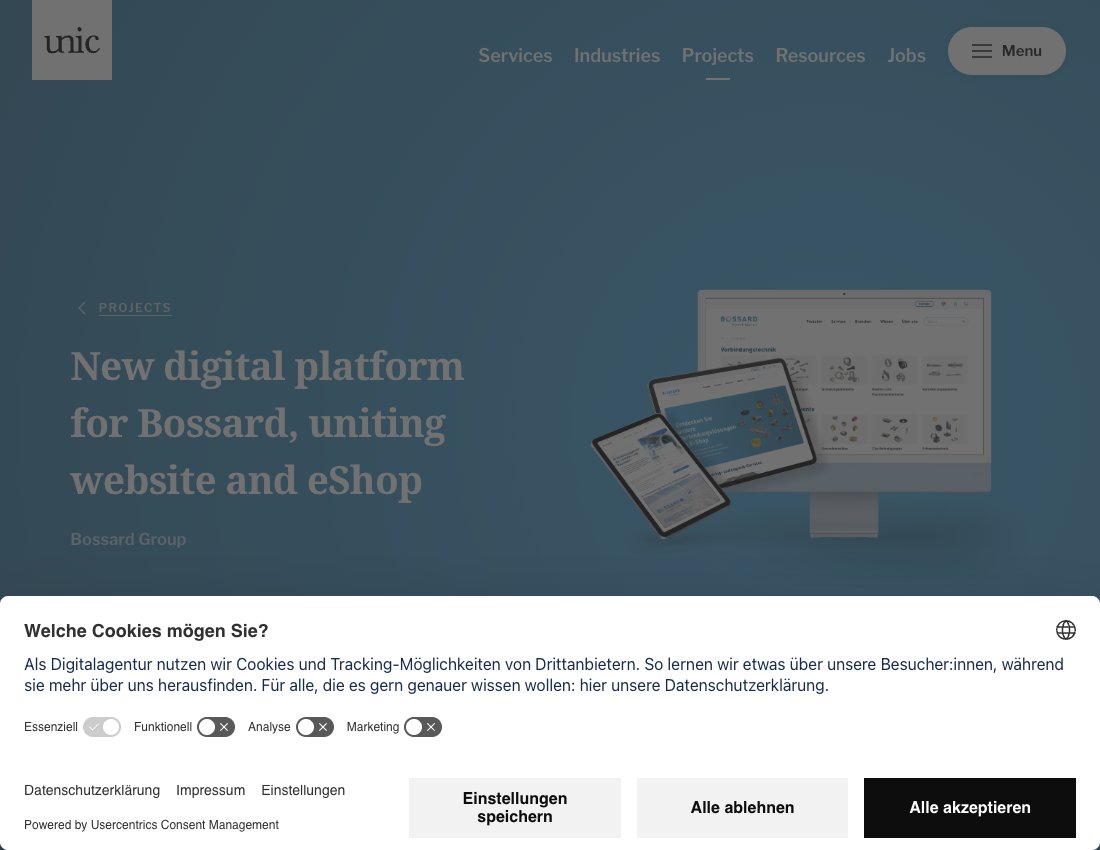
A public Bossard customer account describes connecting content, commerce and CRM. Our client’s questionnaire highlighted the ambiguity of platform hiring: it can indicate internal maintenance or transformation. This page does not present invented buyer interviews.
The source and the distinction+
The quotation comes from Unic’s published project page. Mason’s source material for the sales-context question is the full client questionnaire call of 11 August 2026.
Turn research into a search.
Specific sources. Clear company-fit checks. Evidence beside every account.
09 / FROM RESEARCH TO SOFTWARE
Build a search around the change.
The research became a set of specific sourcing programs. Each has its own sources, evidence checks and company-fit rules. A generic “intent” label would lose the detail that makes the account useful.
Four developed sourcing programs cover new digital or marketing leaders, stack hiring, back-office implementation and product launches. Stack hiring uses Harvest, Serper and Open Jobs. Each source is checked against company and event fit.
Inside the sourcing programs+
Leaders: role start, function and company relevance.
Stack hiring: original role text, platform evidence and company identity.
Back-office: explicit implementation or rollout evidence in hiring, contractor and procurement sources. This program is paused.
Product launches: OTS, Presseportal and PRNewswire, with launch and company checks.
10 / THE ACCOUNT OUTPUT
Keep the reason beside the account.
The software brings the evidence into an account dossier: what changed, where we found it, whether the company fits, and who may own the work. The team can review the account with its context intact.
On 12 October 2026, the reviewed stack-hiring test published four source-backed accounts and passed desktop and mobile acceptance. Source coverage remains partial. Automatic recurring runs are off and the back-office program is paused.
What is working today+
The latest reviewed stack test published four accounts. The latest reviewed product-launch test published one account. These are individual test results, not a promised daily volume.
Source limits and held records remain visible in the operational receipts. The case-study build has not enabled schedules or resumed paused research.
Start a relevant conversation.
Give the right person something useful to discuss.
11 / THE WAY INTO THE ACCOUNT
Find a useful way into the conversation.
Our client sells work that crosses technical and commercial teams. We mapped both sides of that decision and used the account’s context to choose a useful opening: a focused healthcheck, rather than a broad capabilities pitch.


Our client questionnaire described a technical and a commercial decision track, the importance of context and warm routes, and a healthcheck as a low-friction first offer. Listening research supports understanding the person’s remit and expressed interests.
Why this opening fits the client+
Complex platform work is difficult to sell through an anonymous RFP or a generic service pitch. A small, useful review creates a more concrete conversation without assuming that every relevant job post means an agency is needed.
12 / THE FIRST CONVERSATION
Make the message about their project.
The opening should connect the observed change to a question the team can help answer. The account earns its place in the outreach through its context; the message earns a reply by offering something useful.
A proposed stack-hiring email asks whether the company is maintaining its setup or preparing for change, then offers a focused healthcheck. It is a draft, not evidence of a sent campaign, replies or revenue.
Where the case study ends+
The completed work covers the market and customer research, event analysis, sourcing programs, reviewed account outputs and outreach approach. Verified campaign or commercial outcomes are not yet part of this case study.
THE POINT OF THE WORK
A better place to begin
the next sale.
A defined competitor set. Customer relationships with evidence.
Specific changes to look for. Something useful to say.